The Architecture of an Unveiled Melody
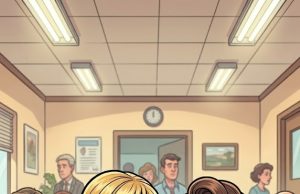
The Grand Horizon Lounge in downtown Savannah was a space engineered specifically for the display of absolute prosperity. Beneath the soaring vaulted ceilings, several massive crystal chandeliers fractured the ambient light into a thousand shimmering fragments, scattering them across a polished marble floor that reflected the evening gowns of the city’s elite like a dark, glossy lake. It was the sort of environment where the air always smelled of expensive tobacco and imported citrus, and where the low, synchronized hum of dozens of private conversations centered around acquisitions, estate trusts, and mergers that involved more capital than the average citizen would ever interact with in a lifetime.
Moving through the dense clusters of wealth with the quiet precision of a ghost was a twenty-six-year-old woman named Elena Vance.
Her charcoal-colored service uniform was damp at the collar from the grueling progression of an twelve-hour shift, but her movements remained disciplined as she balanced a silver tray loaded with empty crystal flutes. She navigated the narrow spaces between velvet banquettes without brushing against a single shoulder or interrupting the rhythm of a single transaction, having perfected the art of being entirely invisible to the people who frequented the lounge. She was a permanent fixture of the room’s background scenery, the unseen hand that erased the evidence of spilled bourbon and disappeared before anyone could look up to offer a glance of acknowledgement.
That was the established order of the evening until a sharp, metallic voice cut through the ambient music and brought the room’s momentum to a sudden halt.
“Hey. You over there with the tray. The custodian.”
Elena froze, her loafers tracking a sudden stillness against the polished stone floor.
The silver tray in her grip vibrated with a faint, high-frequency rattle that seemed to echo in the sudden vacuum of the lounge. Conversations faltered mid-sentence, the clinking of silverware ceased, and dozens of beautifully groomed heads turned toward the source of the disruption. Standing in the center of the mahogany-paneled alcove was Julian Sterling, a prominent venture capitalist whose real estate developments dominated the coastline and whose features were a regular fixture on the covers of regional business journals. He was clad in a midnight-blue wool suit that represented several months of Elena’s rent, and his posture carried the effortless, dangerous confidence of a man who viewed the world as a collection of properties waiting to be acquired.
He pointed a finger directly at her chest, his manicured hand steady under the glare of the chandeliers.
“Step over here for a moment,” he said, his voice carrying the casual arrogance of someone who had never encountered a locked door. “I believe I have a proposition that might interest you.”
A low murmur of collective curiosity rippled through the spectators, who were always eager for a spectacle to break the monotony of the fundraiser. Elena swallowed against the dry heat in her throat, taking a slow, deliberate step forward, and then another, the weight of the entire room pressing down upon her shoulders as she approached the circle of light.
“Yes, sir? Is there something you need cleared from the table?” she asked, her voice pitched low to preserve what little dignity she had left.
Julian adjusted his gold cufflinks, ensuring his voice was loud enough to reach the furthest corner of the lounge.
“I was having a conversation with the venue manager earlier, and he happened to mention that you used to spend a significant amount of time in a studio. He said you were a dancer.”
The crowd let out a soft, mocking collective breath.
Elena felt the blood rush to her ears, a hot, prickling sensation that made the room blur at the edges.
Dance.
It was a syllable that belonged to a landscape she had buried so deeply she had almost convinced herself it had been a dream.
Julian wrapped an arm around the waist of the elegant woman standing beside him, a striking figure named Clara who was draped in a platinum-colored silk dress that caught the light like chainmail.
“If you can actually perform a routine that convinces me you belong on a stage,” he announced with a theatrical sweep of his hand, “I will call off my engagement to this beautiful woman and marry you before the sun comes up.”
An eruption of laughter cascaded across the marble floor, the sharp, brittle sound of an audience watching a performance at a carnival. It wasn’t the laughter of amusement; it was the laughter of exclusion, the sound people make to remind a stranger exactly where the boundaries of the room are drawn.
Clara rolled her eyes with a practiced, socialite indulgence, tapping Julian’s shoulder with a manicured fingernail.
“You are absolutely dreadful, Julian,” she murmured, though she didn’t step away from his side.
Across the room, several guests began to lift their phones, the screens glowing like tiny blue lanterns as they prepared to document the humiliation. Elena stood rooted to the spot, her face burning under the collective scrutiny. Near the service bar, a young bartender offered a subtle, urgent shake of his head, his lips moving silently to form the words: Just walk into the back room.
But her limbs refused the command to retreat.
Julian took a step closer, the sharp, expensive scent of his sandalwood cologne cutting through the heavy air of the lounge.
“Let’s make it interesting,” he said, a patronizing smile spreading across his face. “I will write you a check for fifty thousand dollars right now if you can prove the manager wasn’t exaggerating your talents.”
The room buzzed with a sudden, competitive energy, the guests leaning forward to see if the servant would accept the wager. He extended his hand toward her, his palm open as if he were offering a lifeline, though the glint in his eyes suggested he was simply testing the length of her leash.
For a long, agonizing moment, Elena simply stared at his hand, wondering how a person could possess so much wealth and yet be so profoundly bankrupt of basic humanity.
Then, the orchestra on the raised platform began to play.
The musicians shifted into a slow, melancholic rendition of a traditional waltz, the opening chords drifting through the grand lounge like a fragile, long-forgotten memory. The melody seemed to unlock a door deep within the vault of Elena’s mind, pulling her back fifteen years into the past.
The Rehearsal of the Lost
She was eight years old again, standing in a sun-drenched studio in Savannah, where the mirrors reflected a world that was still gentle and unbroken. She could see herself spinning across the scuffed oak floorboards, her pink tights dusty from the rosin, her laughter bouncing off the glass walls while her mother watched from a folding chair.
Her mother, Sarah Vance, had been a woman of immense patience, her hands scarred from years of working as a seamstress but her spirit entirely untouched by the gray reality of their poverty.
“Keep your chin lifted, Elena,” she had encouraged with a warmth that felt like a physical blanket. “Extend the line of your arms. You were engineered for this movement, sweetheart.”
The young Elena had twirled until the room became a blur of joy, completely dizzy with the belief that the horizon belonged to her. At the conclusion of the lesson, Sarah had wrapped her in a fierce, lavender-scented embrace, whispering a promise into her hair.
“One day, my love, you are going to stand in the center of the largest stages in this country, and the world will have to stay quiet just to watch you move.”
But the architecture of a child’s dream is a fragile thing, easily dismantled by the cold utility of real life.
When she was fourteen, the music had stopped with the sudden screech of tires on a rainy highway. She remembered standing before a closed mahogany casket, listening to her relatives offer the empty, practiced consolations that people use when they don’t know how to explain a sudden tragedy. Her mother was gone, and within three months, the medical debts had accumulated until the collection agencies began to circle their small home like vultures.
Her father had sat at the Formica kitchen table one evening, his eyes hollowed out by a exhaustion that no amount of sleep could remedy.
“We’re losing the house, Elena,” he had said, his voice a flat, dead line. “Everything your mother left… it’s going to the bank to clear the accounts.”
“But the academy enrollment—” Elena had started, her voice breaking on the syllables.
“The academy is an luxury we can no longer afford,” he had interrupted, his gaze fixed on the floorboards. “You need to find a position that provides a weekly wage. The dream is over.”
A week later, unable to face the ruin of his own life, he had packed a single canvas bag and vanished into the gray mist of the interstate, leaving her entirely alone.
By the time she turned twenty, Elena had accepted the lesson that survival is a demanding master that requires the sacrifice of every beautiful thing you own. She had accepted the position on the maintenance staff at the Grand Horizon Lounge, cleaning the very floors where the wealthy came to display their fortunes. On the night she signed her employment contract, she had stood by the ballroom doors, watching the elegant couples glide beneath the crystal chandeliers, and she had made a silent, desperate vow to herself.
I am going to return to this floor one day, but I will not be carrying a mop when I do.
“Are you still lost in your daydreams, Cinderella?” Julian’s voice snapped through the air, shattering the memory and dragging her back into the glare of the lounge.
More laughter cascaded from the tables. More glowing screens were aimed at her face, waiting for her to break.
But something fundamental within the machinery of her spirit had realigned. The ancient spark that had been buried beneath six years of physical exhaustion and professional humiliation flared back into a brilliant, dangerous light.
Slowly, deliberately, Elena set her silver tray down onto the nearest marble tabletop, the metal clanging against the stone with a resonance that silenced the surrounding conversations.
“I accept your wager, Mr. Sterling,” she said, her voice clear and carrying across the room.
The Black Dress
A profound hush descended over the grand lounge, the guests shifting in their seats as the reality of her acceptance took hold. Julian blinked, his features registering a brief, uncharacteristic flicker of surprise before he managed to reclaim his smirk.
“But,” Elena added, raising a single finger to hold the space, “I intend to conclude my shift first. I have precisely four minutes remaining on my timecard.”
Julian let out a soft, amused chuckle. “Consider your shift concluded, sweetheart. The house will cover the four minutes.”
Across the room, the venue director, a man named Mr. Harrison, was watching the development with a frantic, sweating anxiety. Elena walked directly toward him, her head held high, ignoring the whispers that followed her path.
“Mr. Harrison,” she said with quiet respect, “I am requesting five minutes in the staff changing area. I will return before the next set begins.”
The director hesitated, his eyes darting toward Julian, who offered a brief, dismissive nod of approval. “Five minutes, Elena,” Harrison conceded. “Not a second more.”
She disappeared through the service door into the narrow, concrete hallway that led to the underbelly of the building. The lounge immediately erupted into a storm of excited speculation.
“She’s actually going to attempt it!”
“This has to be some sort of orchestrated publicity stunt for the foundation.”
Julian leaned back against a leather-upholstered chair, turning his gold watch with his thumb. “She’ll slip out through the loading dock,” he stated with absolute certainty. “People of that class always run when the lights get too bright.”
But exactly five minutes later, the heavy oak doors swung open once more, and the room fell into a silence so absolute you could hear the rain hitting the high skylights.
Elena Vance stepped back onto the marble floor.
She had stripped away the gray canvas jacket of her uniform, leaving only a simple, sleeveless black cotton dress that she usually wore for her commutes. Her hair, which had been pinned into a severe, tight bun for the last twelve hours, had been released, falling in loose, dark waves around her shoulders. She wore no jewelry, no cosmetics, and no expensive silk, yet she looked entirely transformed.
She didn’t look glamorous; she looked sovereign.
She stepped onto the center of the dance floor, the white light from the chandeliers catching the clean lines of her collarbone. She looked toward the orchestra conductor, offering a small, elegant tilt of her head.
“If you would be so kind as to return to the beginning of the movement,” she requested.
The conductor offered a brief nod of professional curiosity, and he raised his baton. The waltz began again.
Elena closed her eyes for a single heartbeat, inhaling the scent of the room, and then she moved.
The Architecture of Motion
Her first step was an exercise in absolute control—a slow, elongated suspension that seemed to stretch the very parameters of the time signature. The second step flowed with an organic, weightless fluidness into a breathtaking turn that caused the fabric of her black dress to billow around her ankles like dark smoke.
Within thirty seconds, the entire lounge was locked in a paralysis of attention.
Elena wasn’t merely performing a sequence of steps; she was translating her history into a physical language. Her feet glided across the cold marble with a geometric precision that defied the exhaustion of her shift, the years of discarded training returning to her muscles with the violent, beautiful awakening of an old instinct. Her arms carved through the heavy air with an emotional resonance that made the room feel small.
She spun into a perfect, flawless pirouette, her body centered over a single point on the stone floor, before transitioning into a second, even more complex rotation.
Audible gasps rippled through the rows of tables.
The blue lanterns of the cell phones began to lower as the spectators realized that this wasn’t a joke to be mocked on a screen; it was an act of artistic dominance. The smirks vanished from the faces of the executives, and the laughter was replaced by a heavy, reverent stillness. Elena danced as if the walls of the lounge had dissolved, as if the crystal chandeliers were merely stars in a wide, midnight sky and she was back in the studio with the sun on the floorboards. Every leap carried the weight of the years she had spent in the dark, and every turn was a monument to the promise her mother had whispered into her hair.
As the orchestration climbed toward its swelling, dramatic climax, Elena executed a final, sweeping sequence of turns that covered the entire length of the floor before coming to a violent, perfect halt in the exact center of the room.
The final note faded into the rafters.
For a long, agonizing moment, no one in the lounge moved a muscle.
Then, from a table near the rear, an elderly woman began to clap—a slow, solitary percussion that was immediately joined by a second, and then a third. Within five seconds, the entire ballroom erupted into a roaring, standing ovation that shook the glass partitions of the lounge.
The Rejection of the Check
Julian Sterling stood frozen beside his fiancée, his confident smile having completely vanished from his features, leaving behind a expression of profound, unpolished bewilderment. Clara was staring at Elena with wide, watery eyes, her hand resting over her collarbone.
“That… that was one of the most beautiful things I have ever witnessed in this city,” Clara whispered, her voice carrying across the quiet space.
Elena walked calmly toward the alcove where Julian stood, her breathing shallow but her posture unyielding. She stopped a few feet away and looked him directly in the eye.
“Well, Mr. Sterling?” she asked, her voice steady. “Was the manager exaggerating?”
The venture capitalist looked genuinely embarrassed for the first time in his public life. He reached into the breast pocket of his midnight-blue jacket and produced a leather-bound checkbook, unstopping his pen with a clumsy movement of his fingers.
“You proved your point, Elena,” he said, his voice stripped of its previous arrogance. “You earned the fifty thousand dollars. Tell me who to make the check out to.”
But Elena simply shook her head, her arms remaining at her sides.
“I have no interest in your currency, Mr. Sterling.”
The lounge fell into another dense, confused silence.
Julian frowned, his hand hovering over the paper. “If you aren’t looking for the capital, then what exactly was the purpose of this display? What is it that you want from me?”
Elena looked around the room—at the crystal chandeliers, the faces of the people who had spent the evening looking right through her, and finally at the expansive hardwood floorboards of the stage area.
“I want an opportunity,” she stated clearly.
He blinked, his corporate mind struggling to find the parameter of the request. “An opportunity? Of what nature?”
“There is an unused rehearsal studio on the third floor of this building,” Elena said, her voice resonant. “Your firm acquired the historic deed to this block three years ago. I’ve read the public notices.”
Julian offered a slow, cautious nod. “The third floor is currently designated for storage. What about it?”
“I want you to sign a lease agreement that allows me to convert that space into a non-profit dance academy,” Elena said, her gaze unblinking. “A studio for the children of the east side who cannot afford the registration fees of the suburban schools. A place where the doors are open to anyone who has the music in them.”
The guests exchanged startled, murmuring looks, the conceptual weight of her request shifting the entire evening from a cruel game into a profound challenge. Elena continued, her voice filling the quiet room.
“I will continue to clean these marble floors during the day if that is the price of the lease. But at night… those children deserve the same horizon that was taken from me when I was fourteen.”
The room remained absolutely still, the silence stretching until Julian slowly lowered his pen. He studied her face, tracing the exhaustion around her eyes and the unyielding strength in her jaw, and for the first time that evening, a genuine, unpracticed smile touched his lips.
“You are the first person in five years to stand in this room and ask me for something that didn’t involve increasing their own profit margin,” he admitted, closing the leather checkbook with a decisive click.
He extended his hand toward her, his posture shifting into one of genuine respect.
“We have a deal, Elena. My foundation will cover the cost of the structural renovations and the mirrors. You will manage the curriculum.”
Gasps of surprise rippled through the crowd, followed by a sudden burst of laughter from Clara, who leaned against his shoulder with a look of genuine pride.
“It appears she just completely overhauled your commercial development strategy for the historic district, Julian,” she noted with a smile.
Julian shrugged, his eyes never leaving Elena’s face. “It is likely the most secure investment I’ve seen all evening.”
Elena reached out and closed her fingers around his hand, finalizing the contract in front of the entire assembly. The applause returned then—not the polite, obligatory clapping of a charity gala, but a thunderous, reverent roar that felt like a validation of her mother’s old promise.
As Elena looked out over the dark marble floor, she realized that she had finally fulfilled the vow she had made to herself near the ballroom doors. She had returned to the room, but the invisibility had been stripped away forever. She wasn’t carrying a tray or a cleaning cloth; she was standing in the light, a woman who had reminded every soul in that room that the most beautiful things we possess cannot be bought, and that dreams do not die in the dark—they simply wait for the right music to begin again.